Voilà en résumé. Voici ce que signifie concrètement l'IA native, ses résultats en situation réelle dans les magasins, son coût et les erreurs fréquentes des commerces.
Que signifie réellement « natif de l'IA » ?
Pendant des années, l'IA dans l'usinage se résumait à un boîtier tiers branché sur une machine existante. Les données quittaient la machine, étaient analysées ailleurs, puis revenaient sous forme de rapport que personne ne lisait.
L'IA native est différente. L'intelligence est intégrée au système de contrôle de la machine elle-même. CNC Les commandes sont désormais livrées avec des canaux d'analyse des vibrations intégrés, permettant aux modèles d'IA de fonctionner directement à bord, de filtrer le bruit localement et de ne transmettre que les modèles significatifs.
Ce changement est important pour deux raisons : les décisions sont prises en millisecondes au lieu d’une nuit entière, et les données d’usinage confidentielles restent protégées au lieu d’être transmises brutes au cloud.
Les chiffres d'adoption de 2026
Les données montrent une transition technologique des projets pilotes vers la pratique courante :
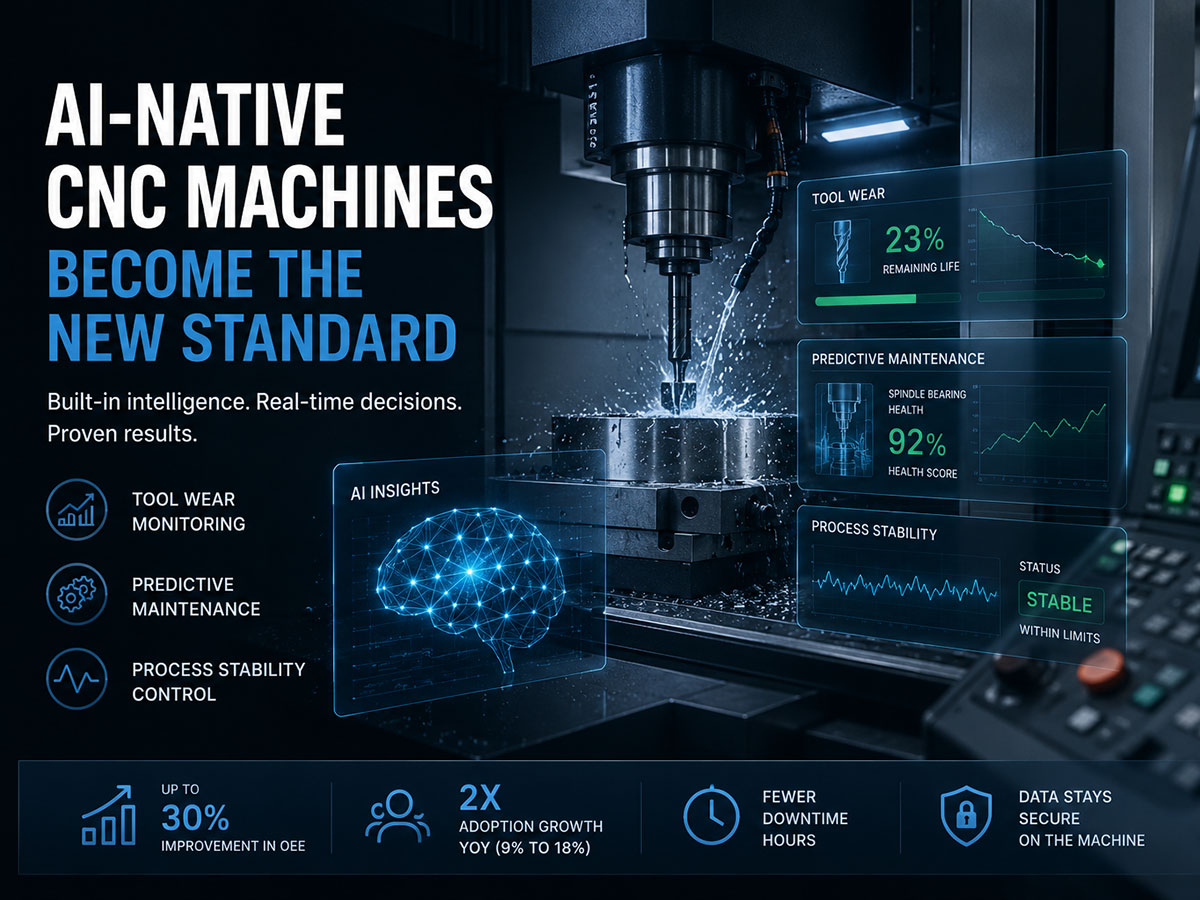
• L’adoption de la maintenance prédictive a doublé, passant de 9 % à 18 % d’une année sur l’autre (Fluke, mai 2026).
• La maintenance réactive « réparer quand ça casse » est restée stable à 36 % des ateliers.
• Les résultats clients rapportés par le fournisseur font état d'une amélioration de 30 % de l'efficacité globale des équipements (IPercept, via MachineToolNews.ai).
• Les compétences de la main-d'œuvre ont été classées comme le principal obstacle à la maturité numérique dans la même enquête Fluke.
• Les rapports sur les tendances de l'industrie citent systématiquement la détection de l'usure des outils, la maintenance prédictive et les recommandations de paramètres de coupe comme les 3 applications pratiques qui gagnent du terrain.
Un avertissement important pour la confiance : les meilleurs chiffres de performance sur ce marché sont des résultats clients communiqués par les fournisseurs, et non des audits indépendants. Considérez-les comme des exemples crédibles, et non comme des garanties de résultats pour votre entreprise.
Les 3 applications qui fonctionnent réellement en 2026
Les rapports du secteur sont exceptionnellement unanimes sur ce point. L'analyse des tendances 2026 de Stecker Machine décrit l'IA dans l'usinage comme étant encore à ses débuts, mais gagnant du terrain dans trois domaines précis. Voici en quoi chacun d'eux sert.
Surveillance de l'usure des outils
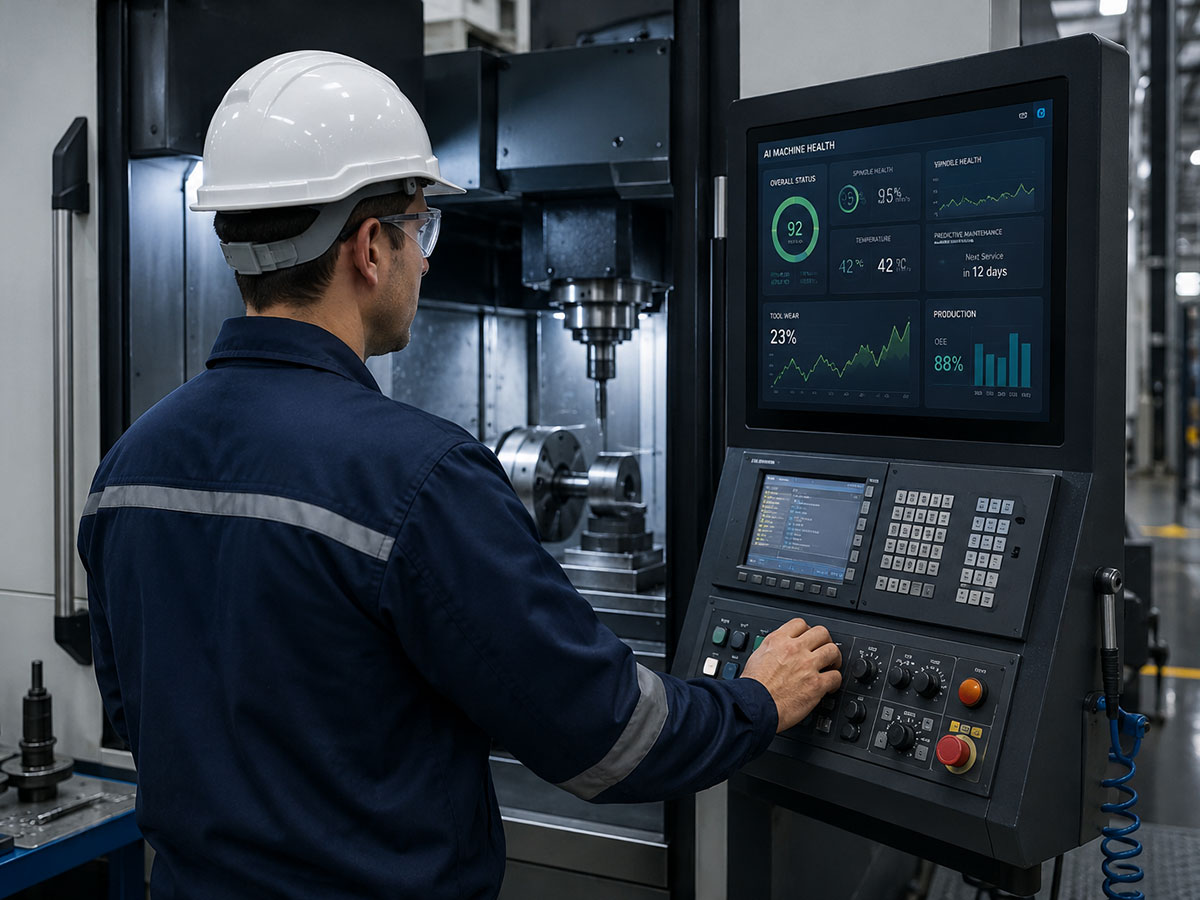
Les modèles d'IA analysent la charge de la broche, les vibrations et les signaux de force de coupe pour évaluer l'usure réelle d'un outil, au lieu de se baser sur un compteur fixe. Le système recommande un changement d'outil juste avant que la qualité ne se dégrade ou que la rupture ne devienne imminente.
Le bénéfice est double. Les ateliers cessent de mettre au rebut les pièces usinées avec des outils défectueux et de jeter des outils encore utilisables. Choisir la qualité. fraises et outils de coupe pour défonceuses CNC Cela reste le fondement ; l'IA ne fait que leur soutirer chaque heure de vie.
Maintenance Prédictive
Cette application offre le suivi financier le plus précis. L'IA analyse les vibrations, la température et le courant normaux de composants tels que les roulements de broche, les vis à billes et les pompes. En cas de dérive, le système signale l'usure naissante, les déséquilibres ou les problèmes de lubrification invisibles à l'œil nu.
Les intervalles d'entretien fixes sont remplacés par des alertes basées sur les données. La maintenance a lieu lorsque la machine en a besoin, et non selon le calendrier. La broche est un élément clé, car une panne de broche figure parmi les incidents imprévus les plus coûteux pour un atelier. Même les opérations de base pratiques d'entretien du fuseau Prolonger la durée de vie ; la surveillance par IA détecte ce que les contrôles de routine ne permettent pas d’identifier.
Contrôle de la stabilité des procédés
Le troisième pilier supervise la coupe elle-même. L'IA analyse les vibrations, la dérive thermique et les variations de charge pendant l'usinage et ajuste les avances et les vitesses pour maintenir le processus dans les limites optimales.
Pour les ateliers à forte diversité produisant constamment de nouvelles pièces, cela améliore la qualité sans nécessiter la présence d'un machiniste expérimenté pour superviser chaque première pièce. Cela rejoint directement les principes fondamentaux abordés dans notre présentation de Comment fonctionne l'usinage CNC ?.
Comparaison des 3 applications d'IA
| Application | Mesure | Maturité | Avantage typique | Exigence principale |
| Surveillance de l'usure des outils | Réduction des coûts liés aux rebuts et à l'outillage | Éprouvé, largement déployé | Moins de pièces mises au rebut, durée de vie des outils prolongée | Données des capteurs de la broche et des axes |
| La maintenance prédictive | Des heures d'indisponibilité imprévues évitées | Éprouvé, croissance la plus rapide | Défaillances détectées avant la panne | Période de données de référence, propriétaire de l'alerte |
| Contrôle de la stabilité du processus | Amélioration du rendement de première passe | Émergent, progressant rapidement | Des tolérances plus strictes dans les travaux à forte mixité | Contrôle moderne, confiance dans les paramètres |
| Usinage entièrement autonome | Nombre d'heures d'extinction des feux par semaine | Pas encore standard | Limité aux emplois stables et récurrents | Des années à attendre pour la plupart des magasins |
La colonne « Mesure » est le filtre pratique. Si vous ne pouvez pas indiquer la valeur que modifiera une fonctionnalité d'IA, vous achetez une démonstration, pas un outil.
Comment sont construits les systèmes natifs d'IA
Toute implémentation sérieuse suit la même structure à 4 couches, qu'elle provienne du constructeur de la machine ou d'un fournisseur de mise à niveau :
• Collecte de données: des capteurs sur les broches, les axes et les pompes enregistrent les vibrations, la température, la charge, le courant servo et l'historique des alarmes.
• AnalyseLes modèles d'apprentissage automatique établissent ce à quoi ressemble la norme pour chaque machine spécifique.
• Prédiction: le système prévoit quel composant est en train de tomber en panne et approximativement à quel moment.
• Action: les alertes sont transmises à une personne qui planifie la réparation avant la panne.
C’est à ce dernier niveau que les projets peuvent réussir ou échouer. L’analyse de CloudNC sur la maintenance prédictive est sans équivoque : les données ne réduisent pas les temps d’arrêt à elles seules. Un atelier ne tire profit que lorsque les données modifient ses décisions. Le même principe s’applique à la maintenance de routine. Entretien des machines CNCUne liste de contrôle n'est efficace que si quelqu'un en est propriétaire.
Combien ça coûte et qui le vend
Les constructeurs de machines intègrent désormais l'IA de série plutôt que comme option. La plateforme CELOS X de DMG Mori connecte les machines, la planification et l'analyse au sein d'un système unique, et la plupart des grands constructeurs proposent des solutions comparables sur leurs nouvelles machines.
Pour les équipements existants, les systèmes de surveillance modernisés coûtent quelques milliers de dollars par machine pour une détection de base et leur coût augmente avec la couverture. Les coûts cachés ne concernent pas le matériel. Prévoyez un budget pour l'infrastructure de données, le temps d'intégration et surtout la formation, car le manque de compétences est le principal obstacle rencontré par les ateliers.
Le point de départ judicieux est ciblé : choisir la machine dont l’arrêt provoque le plus de perturbations, l’instrumenter et prouver la valeur ajoutée avant de passer à l’échelle supérieure. Notre analyse de coût des machines CNC pour métaux montre comment modéliser l'investissement total et le retour sur investissement.
Comment les commerçants posent-ils réellement la question à ce sujet ?
Voici les questions qui circulent actuellement. Si elles vous semblent familières, vous êtes le public cible de cette technologie :
✓ « L'IA est-elle en… » Machines CNC « Réel ou s’agit-il du même système de surveillance des conditions avec une nouvelle étiquette ? »
✓ « Puis-je ajouter la maintenance prédictive à mon centre d'usinage vieux de dix ans ou seulement aux machines neuves ? »
✓ « De combien de mois de données l'IA a-t-elle besoin avant que ses alertes aient une quelconque signification ? »
✓ « Qui surveille les alertes dans une boutique de 5 personnes où chacun a déjà 2 emplois ? »
✓ « L’IA modifiera-t-elle un jour mes flux et mes débits sans me demander mon avis au préalable ? »
✓ « Qu’advient-il de mes données d’usinage, et mon constructeur de machines peut-il voir les pièces de mes clients ? »
Cette dernière question trouve de plus en plus de réponses satisfaisantes. Les systèmes d'analyse embarqués, qui traitent les données localement et ne transmettent que des tendances, et non les données brutes des pièces, deviennent l'architecture standard précisément pour cette raison.
Erreurs courantes lors de l'adoption de l'IA dans l'usinage
Ces problèmes se répètent dans les magasins de toutes tailles. Consultez la liste avant de signer quoi que ce soit :
• Connecter toutes les machines dès le premier jour au lieu de commencer par la plus perturbatrice.
• Acheter la plateforme sans désigner personne responsable des alertes.
• S’attendre à des prédictions utiles avant même que le système n’ait acquis une période d’apprentissage de base.
• Considérer les résultats communiqués par le fournisseur comme des résultats garantis pour votre magasin.
• Négliger le budget de formation alors que le manque de compétences constitue le principal obstacle avéré.
• Choisir un système fermé qui confine les données de votre machine à un seul fournisseur.
• Courir après les gros titres sur l'usinage autonome en négligeant les fondamentaux éprouvés.
• Ne rien mesurer avant l'installation, ce qui rend impossible la démonstration ultérieure de sa valeur.
Et ensuite ?
La tendance à court terme est la convergence. Les plateformes de nouvelle génération combinent l'analyse des broches, la surveillance de l'état des outils, les données de débit du liquide de refroidissement et le retour d'information sur la qualité des pièces dans une boucle d'optimisation unique.
L'objectif est une machine capable non seulement d'anticiper ses propres pannes, mais aussi d'optimiser en continu l'ensemble de l'écosystème d'usinage. À ce jour, aucune source crédible n'affirme que ce soit la norme. La réalité de 2026, confirmée par les rapports du secteur, est celle d'une technologie encore émergente qui apporte des gains concrets, mais limités : moins de rebuts, moins de pannes imprévues et des fenêtres de production plus serrées.
C’est précisément pourquoi le moment est idéal pour commencer. Les entreprises qui constituent dès aujourd’hui des bases de données et mettent en place des systèmes d’alerte sont les mieux placées pour exploiter les capacités autonomes lorsqu’elles seront pleinement développées. Pour en savoir plus sur le contexte de marché qui motive cet investissement, suivez notre Actualités de l'industrie CNC, et pour ce qui est du matériel, explorez le Gamme de machines CNC 5 axes où les commandes compatibles avec l'IA deviennent de plus en plus la norme.
Questions fréquemment posées
Qu'est-ce qu'une machine CNC native à intelligence artificielle ?
Une machine-outil dotée d'une intelligence artificielle intégrée directement dans son système de commande, sans logiciel externe. L'IA traite les données des capteurs embarqués et agit en temps réel.
Quelles sont les applications avérées de l'IA dans l'usinage CNC en 2026 ?
Trois applications dominent le marché : la surveillance de l’usure des outils, la maintenance prédictive et le contrôle de la stabilité des processus. Les rapports de tendances du secteur les identifient systématiquement comme les utilisations pratiques les plus prometteuses, tandis que l’usinage entièrement autonome reste un domaine émergent.
Dans quelle mesure la maintenance prédictive réduit-elle les temps d'arrêt ?
Les résultats varient d'un magasin à l'autre. Les chiffres communiqués par les fournisseurs font état d'une amélioration de l'efficacité globale des équipements pouvant atteindre 30 %, mais il ne s'agit que d'exemples et non de garanties. Les résultats indépendants dépendent de la qualité des données et du suivi des alertes.
Les machines CNC plus anciennes peuvent-elles utiliser la surveillance par IA ?
Oui. Les kits de capteurs adaptables ajoutent la surveillance des vibrations, de la température et de la charge aux machines existantes. L'intégration native sur les nouvelles machines est plus simple, mais l'âge d'une machine à lui seul ne la rend pas inutilisable.
À quel rythme l'adoption progresse-t-elle ?
Une progression rapide à partir d'une base modeste. Une enquête Fluke de mai 2026 a révélé que l'adoption de la maintenance prédictive avait doublé d'une année sur l'autre, passant de 9 % à 18 %, tandis que 36 % des opérations pratiquaient encore la maintenance réactive.
Quel est le principal obstacle à l'adoption de l'IA dans les ateliers d'usinage ?
Les compétences de la main-d'œuvre, d'après les mêmes données d'enquête de 2026. La technologie fonctionne, mais il faut que quelqu'un examine les données, fasse confiance aux alertes et agisse en conséquence.
L'IA remplace-t-elle les machinistes ?
Non. Les systèmes actuels conseillent et alertent, ils ne remplacent pas le jugement. Ils éliminent les approximations liées aux changements d'outils et à la planification de la maintenance, ce qui accroît la productivité des machinistes expérimentés, au lieu de les rendre inutiles.
Quelles données ces systèmes surveillent-ils ?
Les signaux typiques comprennent la charge de la broche, les vibrations, la température, le courant du servomoteur, le nombre de cycles et l'historique des alarmes. Les modèles apprennent la signature normale de chaque machine et signalent les écarts significatifs.
Sources et notes de données
Les données proviennent de l'enquête Fluke de mai 2026 sur l'adoption de la maintenance prédictive, du rapport 2026 de MachineToolNews.ai incluant l'interview d'IPercept, de l'analyse des tendances CNC 2026 de Stecker Machine, de l'étude de CloudNC sur la maintenance prédictive et de la documentation technique d'Amfas et Messer, compilée en juin 2026. Les données de performance communiquées par les fournisseurs sont clairement identifiées. Il est recommandé de vérifier les données d'adoption à mesure que de nouvelles enquêtes sont publiées.
Construisez votre boutique sur des bases modernes
La surveillance par IA offre les meilleurs résultats sur les machines performantes et bien entretenues. Explorer STYLECNC centres d'usinage CNC et machines CNC en métal avec des commandes modernes SYNTEC et OSAI, prêtes pour l'atelier piloté par les données.