Le choix entre les deux familles de disques durs est souvent l'étape où la plupart des acheteurs hésitent, car les deux camps publient des chiffres convaincants. Ce guide vous accompagne pas à pas dans votre processus de décision : comment… Machine à cintrer CNC Ce guide explique comment façonner les métaux, quels types d'entraînements modifient concrètement le fonctionnement en atelier, comment dimensionner la force de frappe et le nombre d'axes en fonction de votre carnet de commandes, et où se cachent les coûts d'entretien. À la fin de ce guide, le choix de la machine idéale pour votre production devrait être une évidence.
Comment fonctionne une presse plieuse CNC
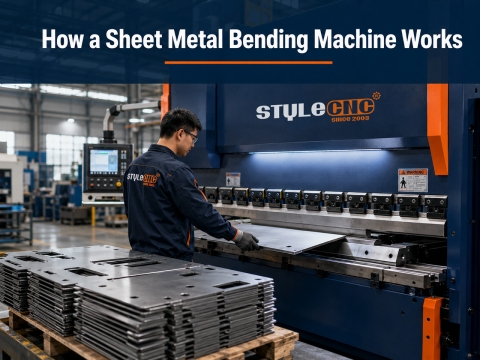
Chaque presse plieuse fonctionne de la même manière. Un vérin enfonce un poinçon supérieur dans une matrice inférieure, et la tôle se plie autour de la pointe du poinçon selon un angle programmé. Le contrôleur coordonne la profondeur du vérin, la position de la butée arrière et la séquence de pliage afin que chaque bride se positionne correctement sur le plan.
La profondeur d'enfoncement du poinçon dans la matrice détermine la méthode de formage. Le pliage à l'air arrête le poinçon avant le fond de la matrice, nécessitant une force minimale et permettant à un seul jeu d'outils de former de nombreux angles, au prix d'un retour élastique plus important. Le pressage au fond presse la tôle complètement dans la matrice pour un contrôle angulaire plus précis. Le poinçonnage va encore plus loin, en frappant la pointe du poinçon dans le matériau sous une force plusieurs fois supérieure pour bloquer l'angle presque parfaitement. La plupart des ateliers modernes utilisent le pliage à l'air par défaut et réservent le poinçonnage au fond aux pièces dont la tolérance l'exige.
La butée arrière est un élément souvent sous-estimé par les acheteurs. Elle positionne la tôle avant chaque passe, et le nombre de ses axes détermine la complexité des pièces réalisables sans repositionnement manuel. Un axe X permet de déplacer les doigts de la butée vers l'avant ou l'arrière, un axe R les relève pour les pièces à brides, et l'axe Z les déplace latéralement pour les pliages décalés.
Les opérateurs ont tendance à formuler la question en termes pratiques : cette machine peut-elle maintenir une précision d’un demi-degré sur de l’acier inoxydable de 2 mm pendant toute la durée du poste, ou combien de cycles sont réellement nécessaires pour réaliser un boîtier à 4 pliages ? Ces deux questions, la constance et le nombre de cycles, permettent de classer les machines plus rapidement que n’importe quelle fiche technique. Un fabricant découpant des ébauches sur une… Découpeuse plasma CNC pour profilage pré-plié Il faudra également que le côté pliage suive le rythme du côté coupe, ce qui fait de la cadence de course une question de production plutôt qu'un critère de confort.
Hydraulique ou servoélectrique : le choix fondamental
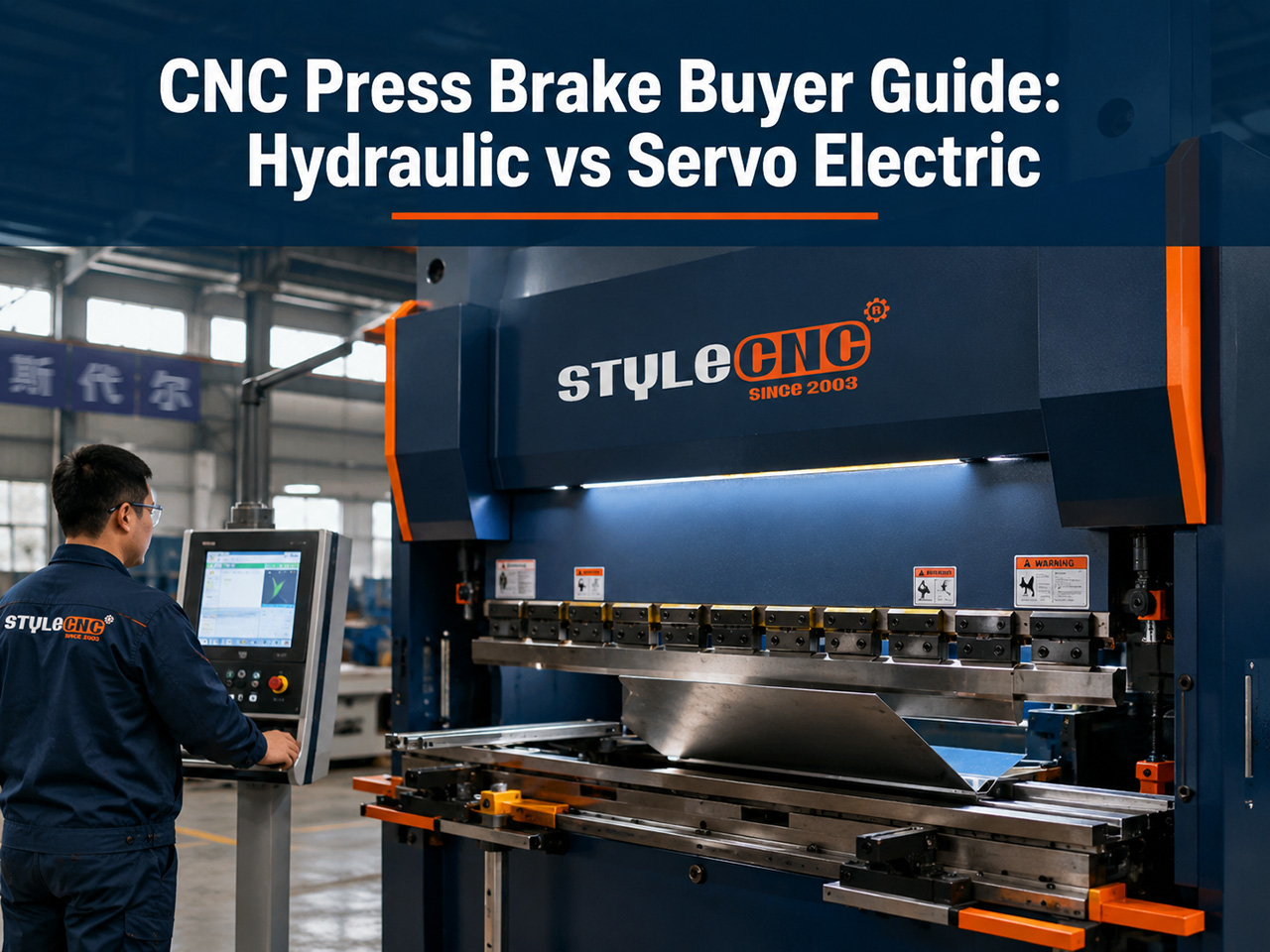
Le système d'entraînement est le principal critère de choix. Les machines hydrauliques actionnent le vérin grâce à la pression d'huile d'une pompe fonctionnant en continu. Les machines servo-électriques, quant à elles, couplent des moteurs à des vis à billes ou à des courroies et déplacent le vérin par commande de position directe.
Les différences mesurables sont suffisamment importantes pour modifier la rentabilité d'un magasin :
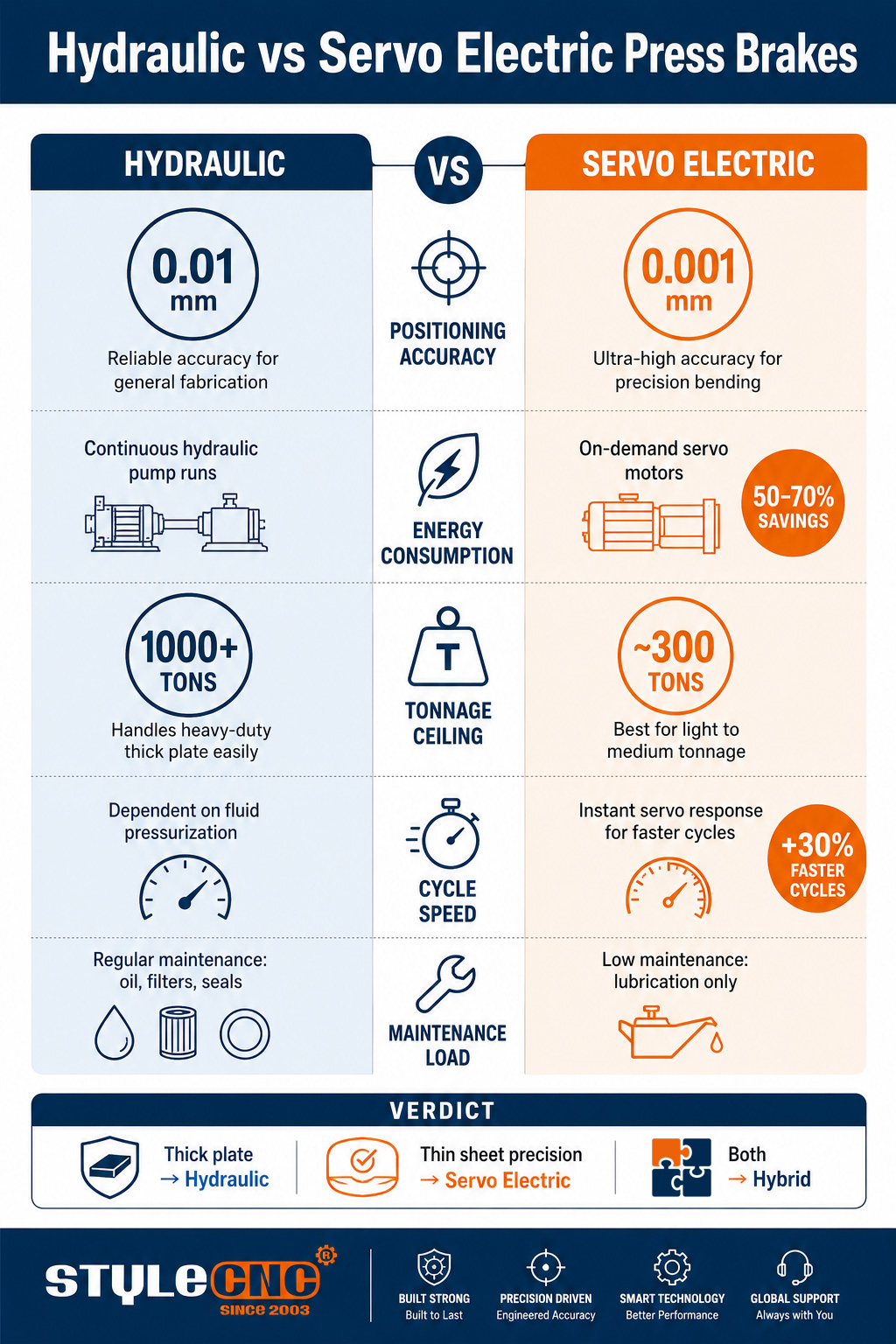
• Les servomoteurs électriques consomment de 50 à 70 % d'énergie en moins que leurs équivalents hydrauliques, car les moteurs ne consomment du courant que lorsque le vérin se déplace.
• La précision de positionnement atteint 0.001 mm sur les machines électriques à entraînement direct, contre environ 0.01 mm pour les vérins hydrauliques classiques.
• Les temps de cycle sont jusqu'à 30 % plus rapides sur les entraînements électriques car le servomoteur réagit instantanément, sans pressurisation du fluide avant la course.
• Les machines hydrauliques restent les plus performantes, dépassant les 1000 tonnes alors que les modèles électriques actuels plafonnent à environ 300 tonnes.
Les études sur le terrain soulignent une mise en garde importante : une grande partie des économies d’électricité annoncées se produisent pendant les périodes d’inactivité, lorsque la pompe hydraulique continue de faire circuler l’huile pendant que l’opérateur manipule les pièces. Si votre machine passe la majeure partie de son temps de travail en charge à cintrer des tôles épaisses, l’écart se réduit. Mesurez la consommation d’énergie par pièce représentative sur votre propre cycle de fonctionnement plutôt que d’appliquer un pourcentage indiqué dans une brochure.
| Facteur | Presse plieuse hydraulique CNC | Presse plieuse servo-électrique | Mesure |
|---|---|---|---|
| Précision de positionnement | Répétabilité du piston d'environ 0.01 à 0.02 mm | Précision jusqu'à 0.001 à 0.003 mm avec les entraînements à vis à billes | Répétabilité du vérin en mm ; à vérifier sur un cintre d’essai, et non sur la brochure. |
| Consommation d'énergie | La pompe fonctionne en continu, consommant de l'énergie même au ralenti. | Les moteurs ne consomment de l'énergie que pendant la course ; consommation réduite de 50 à 70 % | kWh par pièce représentative sur un poste complet, temps d'inactivité inclus |
| plafond de tonnage | Des balances dépassant les 1000 tonnes pour les plaques épaisses | Plafond pratique proche de 300 tonnes dans les conceptions actuelles | Tonnage requis en fonction de l'épaisseur, de la résistance à la traction et de l'ouverture de la matrice |
| Vitesse du cycle | Le fluide doit être mis sous pression avant chaque course. | Réponse servo instantanée, cycles jusqu'à 30 % plus rapides | Nombre de pièces par heure pour votre mélange de pièces actuel |
| Charge d'entretien | Vidange d'huile, remplacement des filtres, des joints, des soupapes et entretien du refroidisseur selon un calendrier établi | Pas de circuit hydraulique ; contrôles de lubrification et de transmission uniquement. | Coût annuel des heures de maintenance et des consommables par machine |
| Meilleur rapport qualité/prix | tôles épaisses, tonnage élevé, fabrication lourde mixte | Feuilles minces, boîtiers de précision, travaux répétitifs en grande série | Répartition des commandes de plus et moins de 6 mm dans votre carnet de commandes |
Un entraînement servo-hydraulique hybride offre un compromis idéal pour les ateliers qui ont besoin à la fois de tonnage et d'efficacité, réduisant généralement la consommation d'énergie de 30 à 50 % par rapport à un système hydraulique à vitesse fixe, tout en conservant une capacité de force élevée que les entraînements électriques ne peuvent pas encore égaler.
Tonnage, longueur du lit et nombre d'axes
Dimensionner la machine en fonction du matériau
La force de pliage requise dépend de trois facteurs : l’épaisseur de la tôle, sa résistance à la traction et la largeur d’ouverture de la matrice. Le pliage d’une tôle d’acier doux de 3 mm sur une table de 3 mètres nécessite une machine très différente de celle utilisée pour le formage d’une tôle de 12 mm, même si les deux sont appelées presses plieuses. L’acier inoxydable requiert environ une fois et demie la force de pliage de l’acier doux à épaisseur égale, tandis que l’aluminium se forme avec moins de force mais reprend sa forme initiale plus facilement, un comportement bien connu des utilisateurs de presses plieuses. travaux de fabrication d'aluminium sur d'autres types de machines.
Achetez la capacité de production adaptée au matériau le plus épais que vous formez régulièrement, puis ajoutez une marge d'environ 20 % afin que la machine ne fonctionne jamais à sa limite. Presse plieuse CNC Vivre à pleine capacité use plus vite et maintient moins bien l'angle de prise de vue.
Le retour élastique est l'autre aspect du dimensionnement. Chaque métal reprend sa forme élastique après le retrait du poinçon, ouvrant le pli d'un degré ou plus selon l'alliage et l'épaisseur. Les systèmes de contrôle compensent ce phénomène en surpliant d'une valeur calculée, mais ce calcul n'est valable que si la machine connaît précisément les caractéristiques du matériau. Les ateliers qui utilisent des tôles certifiées et de qualité constante dans la plieuse obtiennent une répétabilité angulaire bien supérieure à celle des ateliers qui plient des tôles de provenances diverses, quel que soit le coût de la machine. Tenez compte de la régularité de votre approvisionnement en matériaux pour déterminer le niveau de précision que vous recherchez.
Ce que le nombre d'axes vous apporte
Les désignations des axes décrivent les mouvements automatisés par le contrôleur. Les axes Y1 et Y2 contrôlent indépendamment les deux extrémités du coulisseau, assurant son horizontalité même sous des charges excentrées. L'axe X positionne la profondeur de la butée arrière, l'axe R relève les doigts de la butée et l'axe Z les déplace le long du banc. Une machine à 4 axes convient à la plupart des fabrications courantes ; les machines à 6 ou 8 axes ne sont rentables que lorsque la géométrie de la pièce impose un repositionnement constant des butées.
Les ateliers qui réalisent simultanément des travaux de charpente et de tôlerie associent souvent la presse plieuse à d'autres outils. Machines CNC pour la fabrication de métaux Ainsi, la découpe, le pliage et l'usinage restent en interne. La presse plieuse est rentable dès que les ébauches sont conformes aux spécifications, ce qui explique pourquoi les discussions sur la précision du pliage sont souvent liées à la table de découpe.
Contrôleurs, outillage et coût total de possession
La commande numérique constitue l'interface unique entre l'opérateur et la machine. Les commandes numériques modernes simulent graphiquement la séquence de pliage, signalent les collisions avant qu'elles ne surviennent et acceptent des programmes écrits hors ligne, permettant ainsi à la machine de poursuivre le pliage pendant la programmation de la tâche suivante. Lors de la comparaison de machines, il est conseillé de placer un opérateur devant chaque commande pendant une heure ; la différence de temps de configuration entre les interfaces est souvent plus importante que la différence de vitesse du vérin.
L'outillage mérite une ligne budgétaire distincte. Les poinçons et matrices rectifiés avec précision, intégrés à un système de changement rapide, représentent un investissement initial plus important, mais réduisent le temps de changement de série de 30 minutes à quelques minutes. Sur une année de production en petites séries variées, le temps de changement de série engendre une perte de capacité bien supérieure à celle de n'importe quelle spécification machine.
Le bombage est la caractéristique discrète qui distingue les machines à banc long. Sous charge, un coulisseau se déforme légèrement en son centre, ce qui, sans correction, laisserait le milieu d'un cintrage long incomplet. Les systèmes de bombage mécaniques ou hydrauliques pré-courbent le banc pour compenser cette déformation, tandis que le bombage à commande numérique ajuste automatiquement la correction pour chaque opération. Sur les bancs de 3 mètres et plus, renseignez-vous sur la gestion du bombage avant toute autre question de précision, car un coulisseau non corrigé rend toute autre donnée de précision insignifiante sur toute la longueur du cintrage.
Le coût de possession ne se limite pas à la facture :
• Les circuits hydrauliques consomment de l'huile, des filtres, des joints et nécessitent un entretien du refroidisseur chaque année ; les entraînements électriques remplacent cette liste par une lubrification périodique.
• Les différences de consommation électrique de plusieurs kilowatts par heure se cumulent au fil des quarts de travail et des années.
• La formation des opérateurs sur la commande et sur les principes fondamentaux de la tolérance de pliage permet d'éviter les rebuts qui érodent silencieusement les marges.
La manutention des matériaux de part et d'autre du frein est également importante. Les ateliers qui plient pièces en acier pour applications structurelles et de tôlerie On constate généralement que le débit réel d'une cellule de pliage est déterminé par la vitesse à laquelle les ébauches précises y parviennent, c'est pourquoi beaucoup associent la plieuse à un Machine de découpe laser à fibre alimentant la ligne de pliage plutôt que de traiter les deux achats séparément.
Erreurs fréquentes lors de l'achat d'une presse plieuse CNC
• Acheter une précision que le matériau ne peut pas utiliser : un vérin précis à 0.01 mm ne peut pas rattraper une tôle dont l'épaisseur varie de 0.1 mm.
• Dimensionner le tonnage en fonction du travail moyen plutôt que du travail récurrent le plus lourd.
• Ignorer le nombre d'axes de la butée arrière, puis en payer le prix par un repositionnement manuel sur chaque pièce complexe.
• Utiliser les pourcentages énergétiques indiqués dans la brochure au lieu de mesurer les kWh par pièce sur un cycle de fonctionnement réaliste.
• Ne pas inclure l’outillage et les systèmes de changement rapide dans le budget avant l’arrivée de la machine.
Liste de vérification avant de s'engager
• Dressez la liste de vos 5 pièces les plus courantes en indiquant leur épaisseur, leur matériau, leur tolérance et leur tonnage, de la plus lourde à la plus lourde.
• Choisissez le type d'entraînement en fonction du cycle de service : servo-électrique pour les tôles fines et la précision, hydraulique pour les plaques épaisses, hybride lorsque vous avez besoin des deux.
• Vérifiez que les axes de la butée arrière couvrent votre pièce récurrente la plus complexe sans repositionnement manuel.
• Effectuez un essai de pliage sur votre propre matériau et mesurez la répétabilité sur dix coups.
• Prévoir le budget pour l'outillage, la formation et l'installation en même temps que le prix de la machine, et non après.
Construisez votre cellule de fabrication métallique complète
Une presse plieuse fonctionne de manière optimale à proximité des machines qui l'alimentent. Découvrez la gamme complète de Presses plieuses et cintreuses de tubes à commande numérique et obtenez un devis gratuit adapté à votre liste de matériaux et à votre volume quotidien.