Every laser owner eventually holds a sheet of something and wonders whether it can go under the beam. Most materials answer with scorch marks at worst. A short list answers with corroded optics, a gooey fire, or a genuinely poisoned operator. This is the master list of those materials, why each one is dangerous, and the laser-safe substitute that does the same job, so the question never has to be settled by experiment.
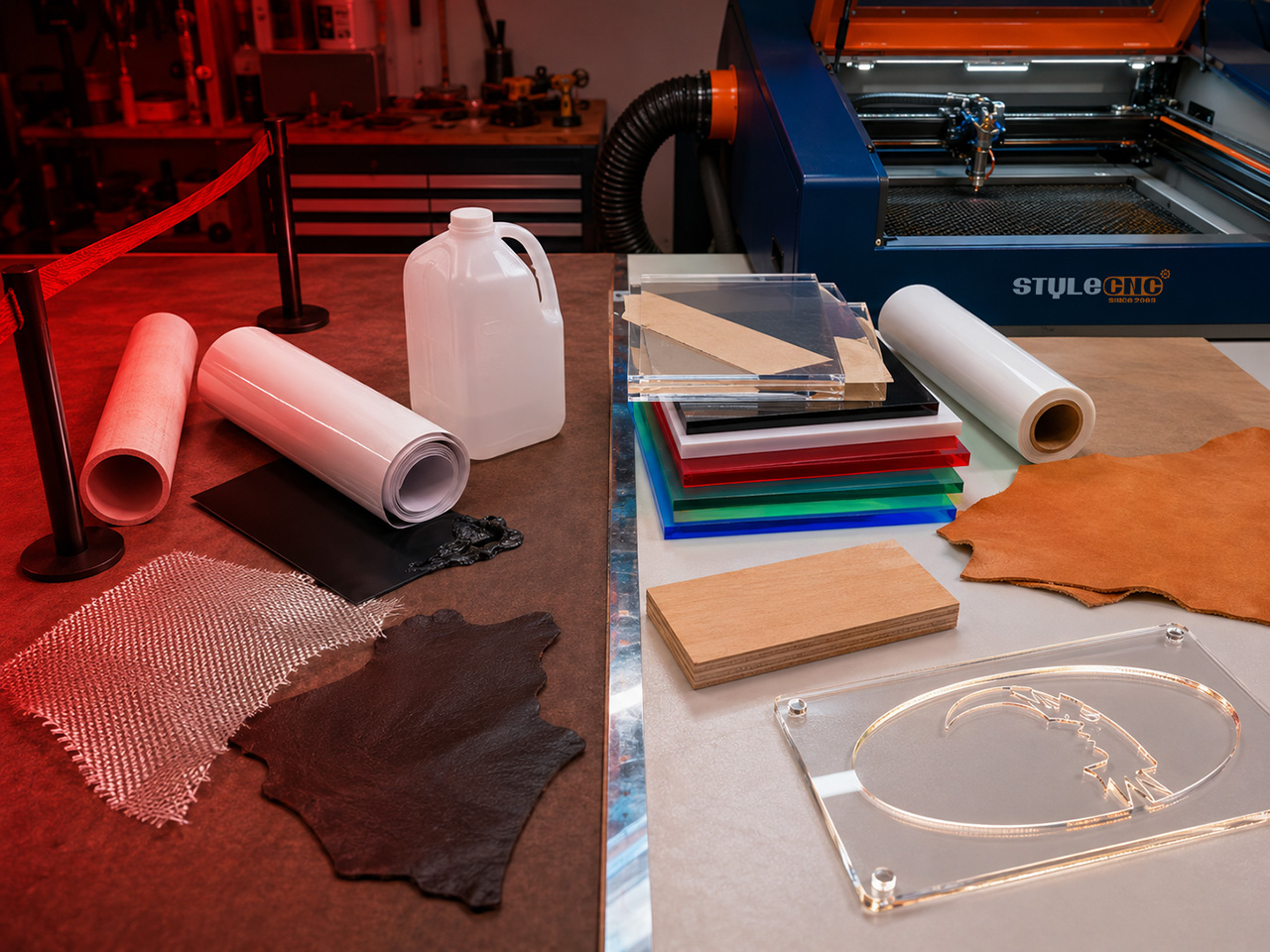
The Forbidden List at a Glance
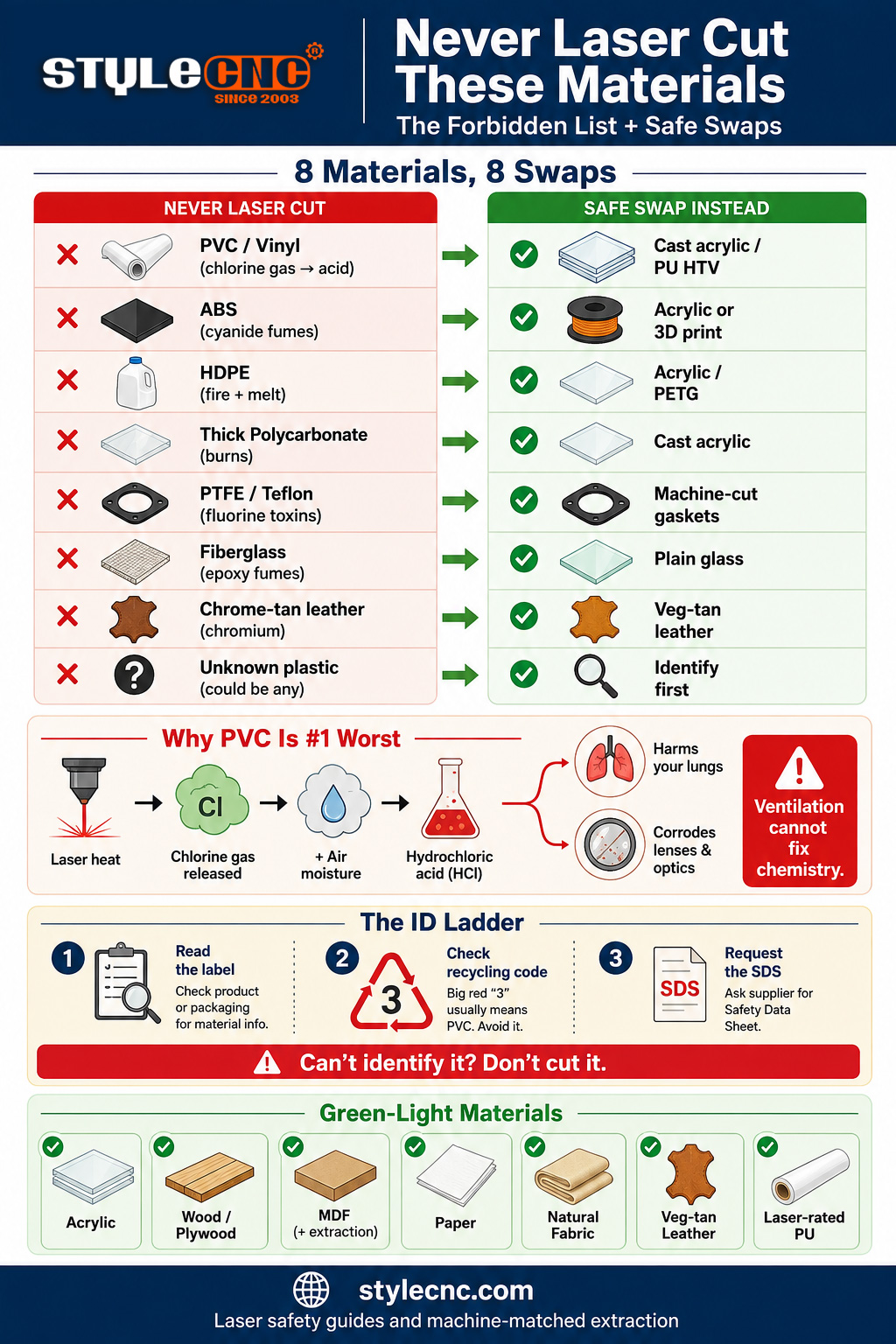
8 materials and material families account for nearly every serious laser incident involving fumes or fire. The table pairs each with its hazard and its safe replacement.
| Never Cut | Pourquoi c'est dangereux | Utilisez plutôt |
|---|---|---|
| PVC / vinyle | Releases chlorine gas; with air moisture it forms hydrochloric acid that attacks lungs, optics, and machine metals | Cast acrylic; laser-rated PU heat-transfer vinyl |
| ABS | Emits hydrogen cyanide and benzene compounds; melts gooey and ignites instead of cutting | Cast acrylic for laser parts; 3D print ABS parts instead |
| HDPE | Catches fire readily and melts into a burning, sticky mess; no clean cut possible | Cast acrylic; PETG (verified grade) |
| Polycarbonate épais | Absorbs IR poorly; discolors, melts, and is a serious fire risk | Cast acrylic for clarity applications |
| PTFE / Téflon | Decomposes into highly toxic fluorine compounds | Machine or die-cut PTFE; laser-safe gasket materials |
| Fiberglass / epoxy composites | Epoxy resin binder produces toxic fumes; glass fibers become hazardous dust | Plain glass (engraving); composites with verified laser-safe resin |
| Cuir tanné au chrome | Releases carcinogenic chromium compounds when burned | Cuir au tannage végétal |
| Any unidentified plastic | Could be any of the above; mystery faux leather, foam, and films are frequently PVC | Identify first: label, SDS, recycling code |
The Worst Offender: PVC, Vinyl, and Everything Chlorinated
PVC is roughly 57 percent chlorine by weight, and laser heat liberates it as chlorine gas. Mixed with the moisture always present in air and in the cut, it becomes hydrochloric acid, which attacks the operator's respiratory system and, just as reliably, the machine: corroded optics, etched rails, damaged electronics, and a contaminated exhaust system that keeps outgassing after the job ends. This is the one material where a single small test cut is genuinely not worth it, and where extraction does not rescue the situation, because exhaust systems move fumes but do not neutralize acid.
The trap is how often PVC hides under other names. Sign vinyl, heat-transfer vinyl, banner material, vinyl tile and wallpaper, cheap faux leather, some craft foams, and some clipboards are all commonly PVC. The identification rule: look for recycling code 3, the words PVC, vinyl, or chlorinated on the label, or request the safety data sheet from the supplier. If a vinyl-like material cannot be confirmed PVC-free, it does not go under the laser. Laser-rated PU heat-transfer vinyl and cast acrylic cover the same signage and decorative jobs safely.
ABS: The Cyanide Problem
ABS fails on 2 fronts at once. Chemically, its decomposition products include hydrogen cyanide along with benzene derivatives, an acutely toxic mix that no shop extraction system is designed to neutralize. Physically, ABS does not vaporize cleanly; it melts, strings, fuses its own kerf shut, and concentrates heat until it ignites. The result is a fire risk with poisonous smoke and a bad edge even when nothing goes wrong.
The substitution is easy because ABS earns its keep elsewhere: 3D print ABS parts where its toughness matters, and cut cast acrylic on the laser for everything flat. Acrylic vaporizes cleanly, cuts with flame-polished edges, and is the reference material the machines are tuned for.
The Fire-and-Mess Tier: HDPE, Foam, and Thick Polycarbonate
A 2nd group is less about acute toxicity and more about fire and unusable results. HDPE, the milk-jug plastic, ignites easily and melts into burning syrup rather than cutting. Polystyrene and polypropylene foams are among the most flammable things a laser can touch and are leading causes of machine fires. Thick polycarbonate absorbs the infrared beam poorly, so instead of cutting it yellows, melts, and eventually flames.
Polycarbonate deserves the nuance it gets in the dedicated guide on whether laser cutting polycarbonate is safe: very thin PC can be processed with care, but sheet thicknesses behave badly enough that cast acrylic is the standing recommendation wherever optical clarity is the goal. Acrylic has its own fume questions, answered in the companion piece on whether laser cutting acrylic is toxic: properly extracted, it is the safe default the forbidden materials are traded for.
Composites and Leather: The Hidden-Ingredient Hazards
Fiberglass looks inert and is not: the glass fibers become fine airborne dust, and the epoxy resin binding them decomposes into toxic fumes, a combination that punishes both lungs and machine. Coated carbon fiber shares the resin problem. Epoxy resins in any form, including resin-coated decorative sheets sold as craft wood, cut badly and fume worse.
Leather splits cleanly down its tanning chemistry. Vegetable-tanned leather is a classic, safe laser material that cuts and engraves beautifully. Chrome-tanned leather, which is most upholstery and garment leather, releases carcinogenic chromium compounds when burned. If the tanning method is not documented, treat it as chrome-tanned and keep it off the bed; laser suppliers sell veg-tan specifically because the distinction matters.
The Unknown-Material Rule
Every hazard above funnels into one operating rule: never cut a material you cannot identify. The verification ladder, in order:
✓ Read the label or listing: PVC, vinyl, CPVC, ABS, or chlorinated anywhere in the name ends the question. Materials sold specifically as laser-safe by laser suppliers are the low-risk path.
✓ Check the recycling code: Code 3 is PVC, never cut. Codes 2 and 4 (HDPE, LDPE) are fire risks. Code 7 means unknown blend, verify before cutting.
✓ Request the safety data sheet: For finished goods like banners, faux leather, and films, the SDS or supplier spec is the only reliable answer.
✗ When in doubt, do not cut: No project is worth chlorine in the shop or cyanide in the exhaust. Extraction systems remove smoke and particles from approved materials; they are not chemical scrubbers and cannot neutralize acid or cyanide gases.
What You Can Cut With Confidence
The safe list is long and covers nearly every project the forbidden materials tempt people toward: cast and extruded acrylic, untreated wood and quality plywood, MDF with good extraction, paper and cardboard, natural fabrics, vegetable-tanned leather, PETG in verified grades, laser-rated PU leatherette, and laser-safe foams from reputable suppliers. Pressure-treated wood is the one wood exception, since older treatments contain arsenic and chromium compounds.
Material choice is half of laser safety; operating practice is the other half. The guide de sécurité pour découpeuse laser covers the extraction, supervision, and fire-prevention side that applies even when every material on the bed is approved. Together with the acrylic and polycarbonate deep-dives above, it forms the full safety reference for STYLECNC laser owners.
Questions fréquemment posées
Can you laser cut PVC?
No, never. PVC is about 57 percent chlorine by weight, and laser heat releases it as chlorine gas that combines with air moisture into hydrochloric acid. The acid damages lungs and corrodes the machine's optics, metals, electronics, and exhaust system, and contamination lingers after the cut. Ventilation does not make PVC safe, because extraction moves fumes without neutralizing them. Use cast acrylic or laser-rated PU materials for the same applications.
Is laser cutting vinyl safe?
Not unless the specific product is confirmed PVC-free, and most vinyl is PVC. Sign vinyl, heat-transfer vinyl, banners, vinyl tile, and much faux leather all commonly contain it, and they carry the same chlorine-to-hydrochloric-acid hazard as rigid PVC. Check the label for code 3, PVC, or vinyl chloride, or get the SDS from the supplier. Laser-safe PU-based heat-transfer vinyl exists and is the correct substitute for cutting; unidentified vinyl stays off the machine.
What happens if you laser cut ABS?
2 bad things at once. The fumes contain hydrogen cyanide and benzene derivatives, acutely toxic gases that shop extraction is not designed to neutralize. And the material itself melts and fuses rather than vaporizing, stringing across the kerf and concentrating heat until it can ignite. Cut cast acrylic on the laser instead, and make ABS parts on a 3D printer where the material behaves.
What are the most dangerous materials to laser cut?
By hazard type: PVC and vinyl are the most dangerous overall, generating hydrochloric acid that injures operators and destroys machines. ABS is the acute poisoning risk via hydrogen cyanide. PTFE/Teflon produces toxic fluorine compounds. Chrome-tanned leather and fiberglass release carcinogenic or toxic fumes from chromium and epoxy respectively. HDPE and foamed plastics are the leading fire starters. Any unidentified plastic should be assumed to belong to this list until verified.
Will good ventilation let me cut these materials anyway?
No. Extraction systems are built to remove smoke and particulate from approved materials like wood and acrylic. They are air movers with filters, not chemical scrubbers, and they cannot neutralize hydrogen chloride, hydrogen cyanide, or fluorine compounds. With PVC, corrosive residue also settles inside the machine and ducting where no fan reaches. The forbidden list is about chemistry, not airflow, which is why the answer stays no at any extraction budget.
Conclusion
The forbidden list is short, specific, and absolute: chlorinated plastics, ABS, HDPE, thick polycarbonate, PTFE, resin composites, chrome-tanned leather, and anything unidentified. Every entry has a safe substitute one shelf away, usually cast acrylic or vegetable-tanned leather, and the identification habit (label, code, SDS) costs a minute per material. Machines are replaceable and projects can wait; lungs and optics are harder to restore.
For the materials that are safe, cut with a machine and practices built for them: STYLECNC laser systems paired with proper extraction and the operating safety checklist cover the approved-material side of the equation. Ask the STYLECNC team about material compatibility for your machine before a new material family goes on the bed.